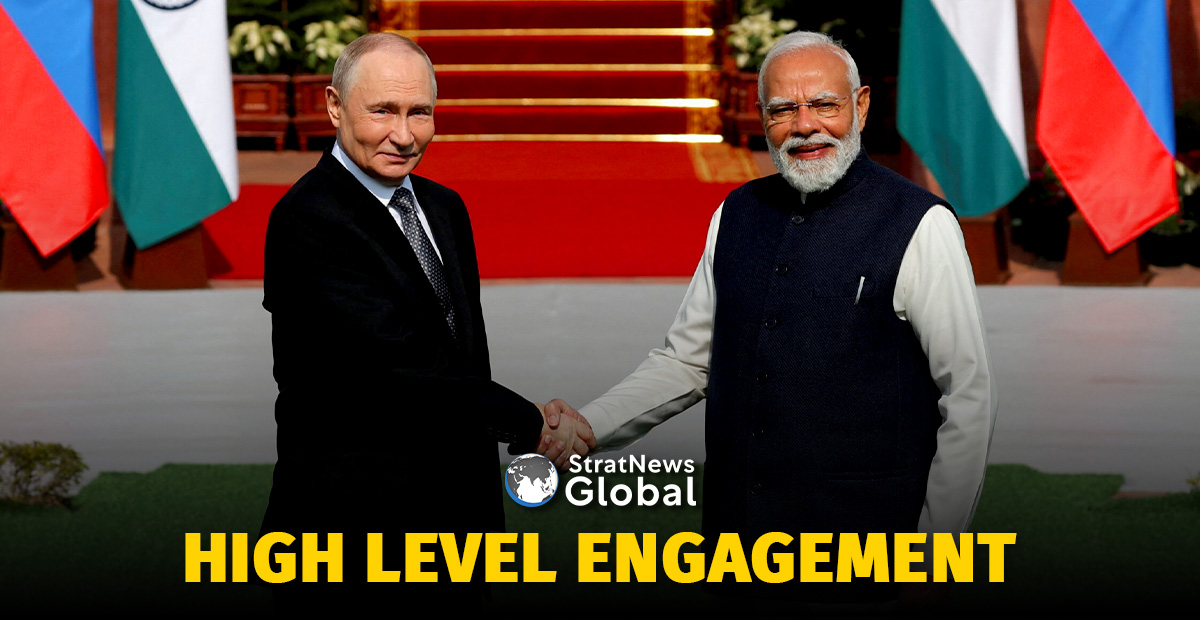
The New Year, diplomatic sources say, is expected to be a period of intense leader-level engagement for India with Europe, the Americas, and the Global South.
Germany’s Chancellor Friedrich Merz is likely to kick off the diplomatic engagement when he lands in Delhi on January 12, the sources said, confirming that the visit will focus on defence (German submarines for India), expanding cooperation in green hydrogen, manufacturing and skilled workforce mobility.
Sources said Germany had recently announced new commitments amounting to “almost 1.3 billion euros, primarily in the form of concessional loans, across the key areas of climate and energy, sustainable urban development, green urban mobility, and sustainable management of natural resources”.
This was following the “successful conclusion” of high level official negotiations on development cooperation 2025 with India.
Later, on January 26, India’s Republic Day celebrations are expected to see European Commission President Ursula von der Leyen and European Council President António Costa. Their visit, officials said, would point to the long-pending India–European Union Free Trade Agreement reaching a “decisive stage”.
Ahead of an expected India-Arab Summit in New Delhi later in the year, officials from 22 Arab countries are coming to India for the 4th India-Arab Senior Officials Meeting (IASOM). The meeting is scheduled to take place on Jan 31, 2026.
AI Diplomacy
Delhi will host the Artificial Intelligence Impact Summit from February 15-20th, which is expected to bring heads of government and senior leaders from 15 to 20 countries, positioning India as a convenor on global AI governance, ethical innovation, and inclusive technological growth.
Among those expected to attend are French President Emmanuel Macron, Italian Prime Minister Giorgia Meloni, and Spanish Prime Minister Pedro Sánchez, alongside leaders from the Indo-Pacific and the Global South.
Diplomatic sources say the presence of multiple European leaders reflects growing alignment with India’s push for human-centric AI frameworks, as well as commercial interest in India’s rapidly expanding digital economy.
Beyond policy discussions, the summit is expected to yield bilateral meetings focused on AI cooperation, semiconductor supply chains, defence technologies, and talent mobility.
Focus on Americas, Global South
March is expected to see intensified outreach to Latin America, with Brazilian President Luiz Inácio Lula da Silva having publicly stated his intention to visit India.
Talks are likely to focus on energy security, food supply chains, defence cooperation, and a substantive expansion of the India–MERCOSUR Preferential Trade Agreement, with more product lines expected to be included.
Uruguay’s top leadership is also expected in New Delhi with discussions likely to centre on cooperation in drones, satellite manufacturing, artificial intelligence and Antarctic scientific research.
Estonia’s President, Alar Karis, is expected to visit India in early 2026 following recent strong political engagements.
Canada, following the stabilisation of bilateral ties in 2025, is also expected to re-engage at the leadership level, with critical minerals, trade diversification, and nuclear energy cooperation on the agenda.
Trade Talks
Indian trade negotiators are aiming to convert the dense diplomatic calendar into economic outcomes. After concluding agreements with the UK, Oman and New Zealand in 2025, New Delhi is now prioritising progress with the European Union, Gulf Cooperation Council, Australia (upgrading ECTA to CECA), ASEAN, and the Eurasian Economic Union.
Officials say the early months of 2026 offer a narrow political window to advance these talks before domestic and international electoral cycles begin to complicate negotiations.
The urgency surrounding early 2026 diplomacy is rooted in the turbulence of 2025. Against this backdrop, Indian policymakers are approaching 2026 with tempered expectations. The emphasis, officials say, is on diversifying partnerships, reducing exposure to external shocks, and securing tangible outcomes rather than headline diplomacy alone.