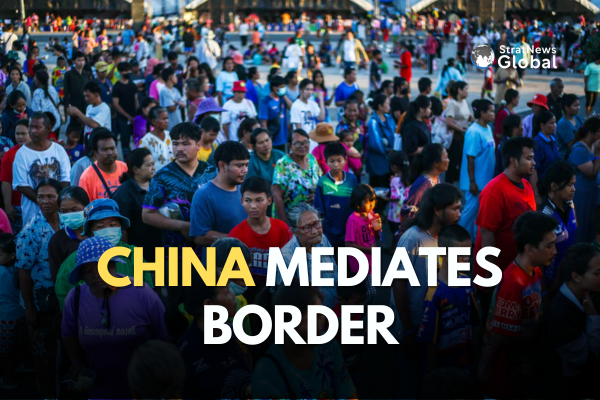
China has called on Thailand and Cambodia to immediately agree to a ceasefire and end weeks of cross-border fighting, urging both nations to pursue dialogue and resolve their disputes peacefully. The appeal comes amid intensifying clashes along their 817-kilometre border, where daily exchanges of rocket and artillery fire have continued for three weeks.
A fragile truce brokered by Malaysia in its capacity as ASEAN chair, with support from U.S. President Donald Trump, collapsed earlier this month, reigniting hostilities. China has since joined regional diplomats in pressing for restraint and renewed negotiations under the auspices of the Association of Southeast Asian Nations (ASEAN).
China Steps Up Mediation Efforts
Beijing’s Special Envoy for Asian Affairs, Deng Xijun, said the “top priority for both sides” was to stop the fighting and return to talks. The Chinese foreign ministry confirmed on Tuesday that Deng recently visited Bangkok and Phnom Penh for discussions with their respective prime ministers and senior officials as part of China’s shuttle diplomacy.
“China supports ASEAN’s mediation efforts and stands ready to create favourable conditions and provide a platform for dialogue between Thailand and Cambodia,” the ministry said.
The two countries are scheduled to hold a meeting of defence officials on Wednesday in an attempt to reinstate the ceasefire a move welcomed by ASEAN as a potential breakthrough in halting the escalating conflict.
Regional and International Context
China has positioned itself as a “friend and close neighbour” to both Thailand and Cambodia, emphasising its commitment to promoting peace “in its own way.” While Beijing did not directly reference the earlier Trump-backed ceasefire, its renewed engagement reflects a bid to assert diplomatic leadership in Southeast Asia at a time of heightened regional instability.
Trump, for his part, has claimed that the Thai-Cambodian conflict was among “eight wars” his administration had helped stop globally — a statement that contrasts with the current situation on the ground.
In an editorial published Monday, China Daily praised Beijing’s diplomatic role, stating that “few actors can claim to have the trust and willingness necessary to sustain mediation efforts as China.” The newspaper likened Beijing’s involvement to its successful facilitation of reconciliation between Iran and Saudi Arabia last year.
A Path Toward De-Escalation
Analysts say that while the conflict remains volatile, the prospect of renewed talks offers a narrow window for diplomacy. ASEAN’s involvement, backed by China’s influence and regional stature, may help both sides avoid a prolonged confrontation that could destabilise mainland Southeast Asia.
Beijing’s call for restraint underlines its growing role as a mediator in regional security disputes a position reinforced by its emphasis on “dialogue, not coercion” as the preferred means of conflict resolution.
with inputs from Reuters