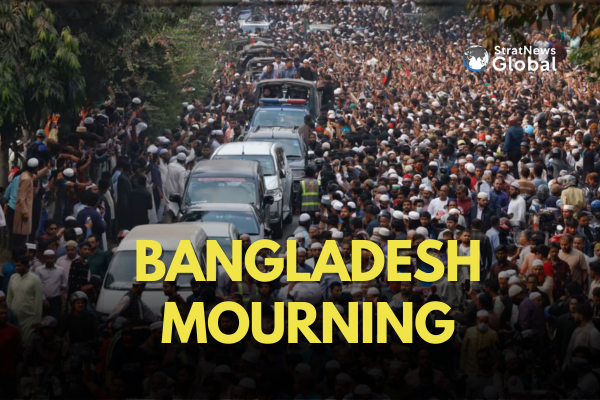
Tens of thousands of mourners gathered in Dhaka on Saturday to bid farewell to Sharif Osman Hadi, a slain youth leader and parliamentary candidate whose death has shaken Bangladesh’s fragile political transition. The 32-year-old, celebrated as a driving force behind last year’s student uprising that ended Sheikh Hasina’s long rule, was shot in the head by masked gunmen during a campaign event last week. He died on Thursday in Singapore after six days on life support.
The funeral, held under heavy security, drew crowds from across the country, including interim government leader Muhammad Yunus, the army chief, and representatives of rival political factions. Police and paramilitary forces were stationed throughout the capital to prevent unrest, and authorities later confirmed that the ceremony ended peacefully.
A Nation in Mourning and Transition
Addressing mourners, Yunus a Nobel Peace Prize laureate vowed to carry forward Hadi’s vision of democratic renewal. “Today, we have come to promise you that we will fulfil what you stood for,” he said, describing the gathering as a national pledge to uphold justice and unity.
In a symbolic tribute, Hadi was buried on the Dhaka University campus beside national poet Kazi Nazrul Islam, a resting place reserved for the country’s most revered figures. The government declared a day of national mourning in his honour.
Hadi’s killing has triggered widespread grief and anger, sparking mob attacks on media outlets and cultural institutions. Demonstrators flooded Dhaka’s Shahbagh area demanding justice and accountability, while violence spread to other cities. In Chittagong, protesters targeted the Indian Assistant High Commission, highlighting growing anti-India sentiment following Hasina’s flight to New Delhi after her ouster.
Rising Tensions Ahead of February Election
Bangladesh is scheduled to hold parliamentary elections on 12 February — a pivotal moment many hope will restore stability after nearly two years of political turbulence. The interim government, however, faces growing scrutiny over its ability to contain unrest and manage competing interests among secular, nationalist and Islamist groups.
Analysts say the unrest has exposed the limits of Yunus’s authority and could threaten Bangladesh’s recovery as one of Asia’s fastest-growing economies. The country, home to 175 million people, remains the world’s second-largest apparel producer after China.
The banned Awami League, led by Hasina, has threatened further agitation, fuelling fears that escalating violence could derail the vote.
Rights Groups Demand Accountability
Human rights organisations have condemned Hadi’s killing and the attacks that followed. Human Rights Watch called it a “terrible act” and urged swift government action to stop the spiralling violence. Amnesty International demanded independent investigations into both the assassination and subsequent assaults on journalists and activists.
Media offices, including those of leading newspapers and cultural groups such as Udichi Shilpigosthi, have been targeted in recent days. Bangladesh ranks 149th of 180 countries in the World Press Freedom Index, and rights advocates warn that continued hostility toward the press could narrow civic space ahead of the election.
As the nation mourns, Hadi’s death has come to symbolise both the promise and peril of Bangladesh’s democratic transition — a struggle now shadowed by grief, uncertainty and the fear of renewed unrest.
(with inputs from Reuters)