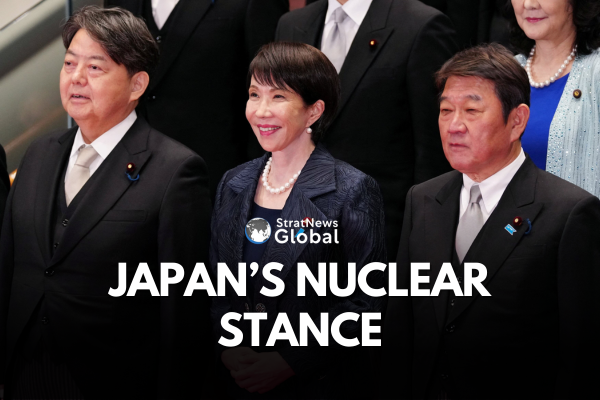
Japan on Friday reiterated its longstanding commitment never to possess nuclear weapons after reports emerged that a senior government official had suggested the country should consider acquiring them to strengthen deterrence against potential threats.
According to local media, including NHK, the unnamed official reportedly attached to Prime Minister Sanae Takaichi’s office argued that Japan’s deteriorating security environment warranted a nuclear deterrent, though such a move would be politically difficult.
Government Reaffirms Commitment to Non-Nuclear Principles
Chief Cabinet Secretary Minoru Kihara told reporters in Tokyo that Japan’s nuclear stance “remains unchanged,” reaffirming adherence to the nation’s three non-nuclear principles: not possessing, producing or permitting nuclear weapons on its territory. He declined, however, to comment on the reported remarks or on whether the official involved would remain in post, as opposition leaders demanded their removal.
Japan’s position on nuclear policy has come under increased scrutiny as regional security tensions intensify. A Reuters investigation in August found growing political and public openness to re-evaluating Japan’s non-nuclear framework. While the idea remains controversial in the only nation ever to suffer atomic bombings, concerns over U.S. reliability under former President Donald Trump and the advancing nuclear capabilities of China, Russia and North Korea have fuelled debate.
Domestic Debate Over Nuclear Deterrence
Some members of the ruling Liberal Democratic Party (LDP) have argued that Japan should allow the United States to deploy nuclear weapons on its submarines or other platforms within Japanese territory as a deterrent measure. The discussion, while sensitive, reflects a shifting national mood over how best to ensure Japan’s security.
Prime Minister Takaichi herself prompted speculation last month when she declined to clarify whether her government would uphold the three non-nuclear principles in a new defence strategy expected next year. Analysts say such remarks may be part of a deliberate effort to test public and political sentiment.
“Putting these trial balloons out creates an opportunity to start building consensus around changes in security policy,” said Stephen Nagy, a professor of politics at the International Christian University in Tokyo. He added that China’s assertive behaviour, along with closer military cooperation between Russia and North Korea, is “creating momentum to rethink Japan’s security approach.”
Historical Sensitivities and Regional Reactions
Taro Kono, a senior LDP lawmaker and former defence and foreign minister, said on Friday that Japan should not avoid a “broad and open debate” on whether it should possess or host nuclear weapons. Yet such discussions remain deeply sensitive, shaped by the legacy of Hiroshima and Nagasaki and the constraints of Japan’s pacifist constitution.
Any reconsideration of Japan’s non-nuclear principles would likely provoke strong reactions from its neighbours, particularly China. Relations between Tokyo and Beijing have already soured after Takaichi said last month that a Chinese attack on Taiwan threatening Japan could trigger a Japanese military response. Beijing, which claims Taiwan as its own, sharply criticised the remark.
For now, Tokyo continues to walk a careful line reaffirming its non-nuclear stance while navigating an increasingly unstable regional security environment.
(with inputs from Reuters)