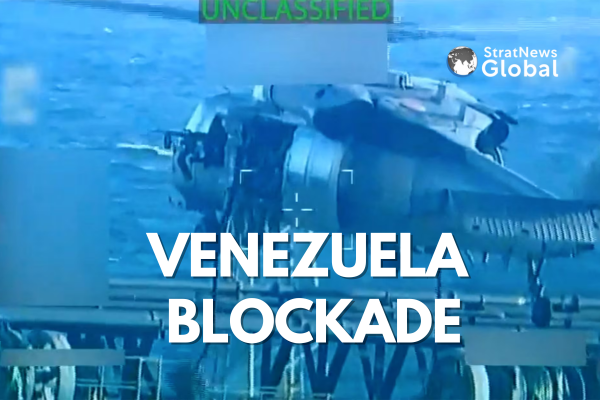
President Donald Trump’s decision to impose a partial blockade on Venezuela marks one of his administration’s most forceful attempts to pressure President Nicolás Maduro. Yet the move, aimed at choking off Venezuela’s vital oil revenues, could inadvertently weaken Washington’s ability to counter Chinese coercion against Taiwan.
On Tuesday, Trump ordered a “total and complete blockade” on all sanctioned oil tankers entering or leaving Venezuela. The measure, designed to cut off the Maduro government’s main source of income, has already sparked legal debate over whether it constitutes an act of war under international law.
Strategic Ripples in the Indo-Pacific
In the Indo-Pacific, U.S. defence planners have long warned that China could employ a naval blockade to force Taiwan into submission. Analysts now say Beijing might exploit Washington’s blockade of Venezuela as a propaganda tool to justify similar coercive actions in the Taiwan Strait.
Craig Singleton, a China specialist at the Foundation for Defense of Democracies, said the U.S. move risks giving Beijing rhetorical cover. “If the U.S. blockades to change political outcomes in Venezuela, China can justify coercive measures against Taiwan on so-called security grounds,” he explained. While the legal circumstances differ, Singleton added, international precedent is often shaped by narrative as much as by law.
“When Washington blurs terms, it weakens its ability to call out coercion elsewhere,” he said.
Escalating Confrontation with Venezuela
The blockade follows a string of U.S. military actions against Venezuela, including strikes on suspected drug-trafficking vessels. Trump’s administration maintains that Maduro and senior officials are linked to the narcotics trade, while Caracas claims Washington seeks regime change and control of the country’s vast oil reserves.
A White House spokesperson said Trump remains committed to “using every element of American power” to curb drug flows and hold those responsible accountable, but declined to address concerns over Taiwan.
China, Venezuela’s largest oil customer, swiftly condemned the U.S. action, denouncing what it called “acts of unilateralism and bullying” and pledging support for nations defending their sovereignty.
Chinese Blockade Drills and Legal Fallout
Beijing has repeatedly conducted blockade-style military exercises around Taiwan and could present any future encirclement as a domestic law enforcement effort. Taiwanese officials, however, view such tactics as acts of war that would severely disrupt global trade.
Isaac Kardon, a maritime expert at the Carnegie Endowment for International Peace, said Washington’s decision risks eroding international norms. “Ultimately, the U.S. is doing a lot of damage to the normative quality of the rules,” he said. “That is a major blow to the credibility of international law to restrain other actors.” Kardon warned that the move could embolden China to intercept vessels bound for Taiwan carrying essential energy supplies.
Milena Sterio, a maritime law scholar at Cleveland State University, noted that a blockade is permissible under international law only during armed conflict. “A U.S. blockade would undermine our ability to criticise a Chinese blockade of Taiwan,” she said, highlighting the inconsistency such a move presents.
Balancing Realpolitik and Credibility
Despite these concerns, some analysts doubt that the blockade will significantly alter allied support in a Taiwan crisis. Michael Hunzeker, a Taiwan security expert at George Mason University, said that references to Venezuela would likely serve as rhetorical justification rather than genuine policy shifts. “I highly doubt this episode will reshape how they assess those interests,” he said.
Nonetheless, experts warn that the prolonged deployment of U.S. naval assets in the Caribbean could stretch military readiness, leaving Washington less able to respond to tensions in the Taiwan Strait a strategic theatre central to Trump’s national security agenda.
(with inputs from Reuters)