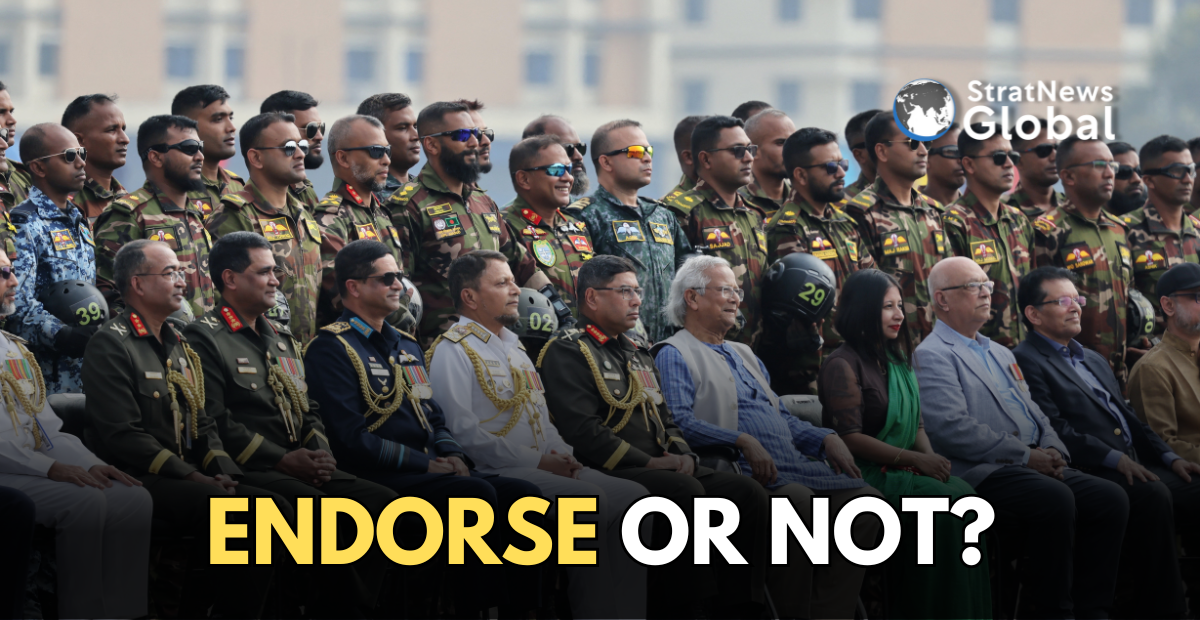
Should India endorse whatever the result of the elections in Bangladesh next February?
Veena Sikri, former high commissioner to Bangladesh, believes that “India must insist on inclusion of all parties because if there is no transparency, there will be continuing instability, continuing chaos, continuing exodus, as we saw in 1971.”
Sikri was referring to how the Awami League was not being allowed to contest, in effect removing a key political player from the hustings. She was speaking at a dialogue on Bangladesh organised by the ORF.
Another speaker, senior journalist Kanchan Gupta, warned of the possibility of rigging, noting strong support from the US and Europe for Interim Adviser Mohammad Yunus. He said there seemed little doubt of the role of the American establishment in the regime change that led to Hasina’s ouster. He noted continued support for Yunus despite crimes against minorities.
Both Sikri and Gupta felt that Bangladesh was moving into a situation similar to that in 1971, when, despite Mujibur Rahman winning the election in East Pakistan, the result was denied by the army ruling in the West.
Journalist and author Deep Halder struck a note of caution, pointing out that although the BNP is the single largest party in the election, the rise of the Jamaat-e-Islami cannot be ignored. In his view, young people remain vehemently anti-Hasina, but there may come a time when civil society does a rethink, that the Hasina years were better than what came after.
Halder says it is too early to tell whether the next PM will be a BNP leader, a Jamaat leader, or a BNP leader who is actually a Jamaat guy. Everything points to a Jamaat element in the upcoming elections.
As for India, whether it endorses the elections in Bangladesh or not, New Delhi would have to find a way to engage with the next government in Dhaka.