China’s recent strategic advances look less like isolated initiatives and more like components of a long-term effort to shape the foundations of global power.
That is the central argument of a Foreign Affairs January/February 2026 article by Elizabeth Economy, published December 9, 2025. She lays out how Beijing has been steadily positioning itself to shape the rules, tools, and institutions that will define emerging strategic domains.
Rather than reacting to momentary crises, China has long pursued influence over areas such as the deep ocean, the polar regions, outer space, cyberspace, and the international financial system.
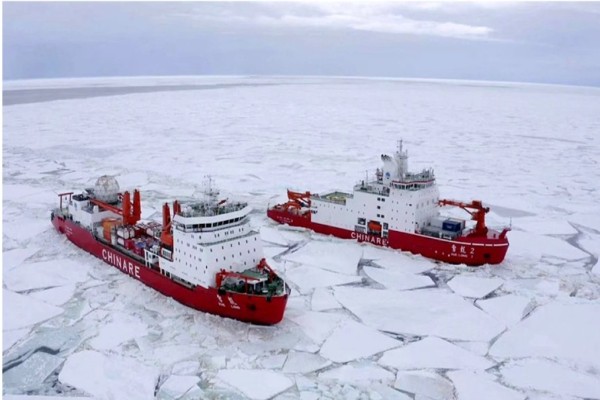
Economy begins with a symbolic example: a Chinese cargo ship arriving in the United Kingdom by traversing the Arctic. The route itself is not the story; it is the signal. For Beijing, this was evidence that new frontiers—from shipping lanes to resource zones—are becoming accessible, and China intends to be deeply involved as these spaces take shape.
She notes that Chinese leaders have been thinking in these terms for decades, treating places such as the deep sea, the poles, and space as the structural foundations of future strength. Under Xi Jinping, the approach has only sharpened: invest in capabilities, embed Chinese experts inside international institutions, create new institutions when the existing ones do not suffice, and adjust tactics continually to widen influence.
China’s deep-sea programme reflects this long-term pattern. While the United States pursued deep-seabed mining sporadically in earlier decades, China built a layered ecosystem of research institutions, specialised vessels, submersibles, and legal frameworks. It has been a consistent and active presence within the International Seabed Authority, submitting papers, shaping draft regulations, and placing officials in key positions.
Chinese companies hold more ISA mining exploration contracts than any other nation, and Beijing has cultivated partnerships with developing countries through training centres and joint research. Yet resistance remains: many ISA members want a moratorium on mining activity until environmental safeguards mature, and some BRICS partners have taken more cautious positions.
Even so, China continues to expand its technological capabilities, including systems that can support both commercial extraction and military operations.
The Arctic presents a similar mix of ambition, investment, and selective pushback. Though China is not an Arctic state, it has promoted the idea that the region’s future concerns all nations, not just those with territory there. It has built scientific programmes, joined the Arctic Council as an observer, and encouraged the development of what it calls a “Polar Silk Road”.
Many democratic Arctic governments, however, have blocked or unwound Chinese investments due to security concerns. But where doors have closed in the West, they have opened wider in Russia. Following Russia’s international isolation after the 2022 invasion of Ukraine, the two countries deepened cooperation in Arctic projects, from resource extraction to transportation infrastructure. They also conducted joint exercises in surrounding waters.
Yet despite this alignment, Moscow has not endorsed China’s larger claim to expanded Arctic decision-making, underscoring that even close partnerships have limits.
China’s space programme, decades in the making, is one of the clearest examples of how Beijing has converted long-term planning into tangible influence. From early satellite work to Xi’s declared goal of becoming a leading space power by 2045,
China has built a formidable scientific, commercial, and military presence. Its satellite constellation is large and increasingly sophisticated, and its space ambitions include a permanent lunar research station developed jointly with Russia. The initiative is designed as an alternative to the U.S.-led Artemis program and its associated accords.
But despite aggressive outreach, only a small number of countries have joined China’s lunar project, and several of them have also signed the Artemis Accords. Those accords have gained far broader traction because they rest on existing partnerships, clear norms, and opportunities for countries to advance their own space industries.
Beijing has also struggled to persuade the international community to embrace its approaches to space security, including treaty proposals that have attracted support mainly from diplomatically isolated countries.
Economy then turns to cyberspace, where China has used industrial power, infrastructure exports, and standards-setting bodies to influence the next generation of digital systems.
Huawei and ZTE have achieved major global market shares in telecommunications equipment, while the Beidou navigation system competes with GPS in accuracy across many regions. The larger ambition is to shape the architecture of future networks. China’s standards push—embodied in initiatives such as China Standards 2035—has flooded global technical organisations with proposals.
The most controversial has been the “New IP” concept, developed with state-owned firms and presented as an alternative to existing Internet protocols. Critics from the United States, Europe, and Japan viewed the proposal as enabling far greater central control over data routing.
Although opposition slowed its adoption, Beijing has continued promoting variants through different forums, a tactic Economy describes as persistent and adaptive.
The financial realm forms the fifth frontier. For China, reducing the dominance of the U.S. dollar is not merely a monetary ambition but a strategic one. The renminbi’s share of global payments remains small, yet Beijing has built a parallel architecture: renminbi-denominated trade settlement, extensive currency swap lines, and a cross-border payment system that offers an alternative to SWIFT.
Sanctions imposed by the United States and Europe have inadvertently created incentives for other countries, especially Russia and Iran, to reduce reliance on the dollar. BRICS members have also supported expanded use of local currencies, even if they do not directly advance the renminbi’s status.
Full internationalisation remains constrained by China’s own reluctance to liberalise its financial system, but partial de-dollarisation advances Beijing’s strategic goals without requiring sweeping reforms.
Economy concludes by describing a global landscape in which China’s gains are real but incomplete. Many countries remain wary of Beijing’s proposals, and in no frontier has China secured uncontested leadership. Yet the accumulation of capabilities, institutions, and influence across these domains gives China forward momentum.
The United States, she argues, must choose between retreat, compromise, or competition. Genuine compromise appears limited by fundamentally different visions for governance, leaving active competition as the only realistic path.
Washington has taken scattered steps like supporting mining prototypes, backing digital assets linked to the dollar, accelerating space initiatives, but these do not yet amount to sustained long-term strategies.
Economy’s argument is ultimately that China has not yet won the future, but it has charted a patient and deliberate course across the world’s emerging strategic spaces. Whether the United States can respond with equal coherence and conviction remains the unanswered question.