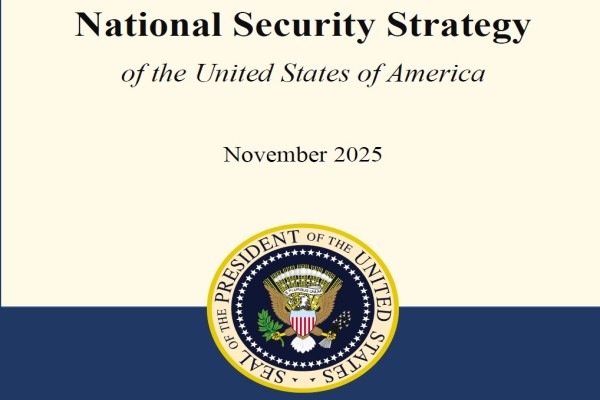
The recently released United States’ new National Security Strategy (NSS) has sparked conflicting reactions in Indian strategic circles.
The document’s focus on national interest—border security, industrial revival and selective international engagement—bears the clear imprint of President Donald Trump’s America First agenda.
Reflecting shifting priorities within the United States, it declares that “the era of mass migration is over”, links illegal entry to national security, and prioritises energy independence based on oil, gas, coal and nuclear power, while rejecting Net Zero frameworks.
It also highlights operations such as Midnight Hammer—said to have degraded Iran’s nuclear programme—as evidence of a willingness to act decisively when national interests are at stake.
The Council on Foreign Relations (CFR) notes that this NSS marks a departure from earlier U.S. strategies that framed America as a defender of a global rules-based order, describing it as a deliberate shift toward a more transactional approach to foreign partnerships.
Europe is no longer presented as a security theatre requiring extensive U.S. leadership. Instead, the strategy calls on European countries to take responsibility for their own defence and navigate the Ukraine conflict without heavy American reliance.
This reordering reinforces the idea that U.S. strategic focus and political bandwidth will now be directed toward the Indo-Pacific and implies Washington expects key partners—including India—to take firmer positions in regional security debates, especially relating to China and Taiwan.
While China is not described in dramatic Cold War–style language in the document, recent statements by senior U.S. military officials reinforce the view that Beijing remains the “pacing threat”, and Taiwan is singled out as a continuing priority.
A similar repositioning is visible in the Middle East. Rather than treating the region as a drain on American resources requiring prolonged military deployments, the NSS frames it as an area moving toward stability through energy partnerships, counterterror cooperation and selective intervention.
The document points to actions such as the strike on Iran’s nuclear capability as proof that Washington will act sharply when core interests are threatened but does not see the Middle East as a theatre requiring ongoing large-scale U.S. involvement.
For India—dependent on the region for energy, trade and a large expatriate community—this shift could reshape economic and strategic dynamics, particularly regarding Iran and Gulf security commitments.
Another striking element in the NSS is how it treats Russia. Unlike earlier strategies that placed Russia alongside China as a major threat, Moscow is now described in more moderate terms.
This is significant given Russian President Vladimir Putin’s December 4–5 visit to India, where the two nations signed agreements on defence supplies, energy, fertilisers and long-term industrial cooperation.
The timing—shortly after the NSS’ late-November release—highlights India’s intent to preserve longstanding ties with Moscow even as U.S. expectations rise.
Some Indian analysts also worry the new U.S. posture could extend beyond diplomacy or defence pressure. They argue that if New Delhi resists deeper alignment, Washington could rely on indirect levers in South Asia—including a more assertive Pakistan or Bangladesh—to complicate India’s regional environment.
Others warn of softer forms of influence: information campaigns, civil society pressure, and online mobilisation among Gen Z, who are increasingly vocal on caste, regional, linguistic and identity issues.
These fears reflect a belief that future geopolitical competition may unfold not only through alliances and borders but also through public sentiment and internal narratives.
Two clear views are now visible in New Delhi.
One sees opportunity: deeper cooperation with the United States could strengthen India’s role in the Indo-Pacific, expand supply-chain integration, and accelerate defence and technology collaboration.
The other cautions that without firm guarantees, India risks dependence on an unpredictable U.S. position—even as it manages a tense border with China and continues to rely on Russia for critical systems and supplies.