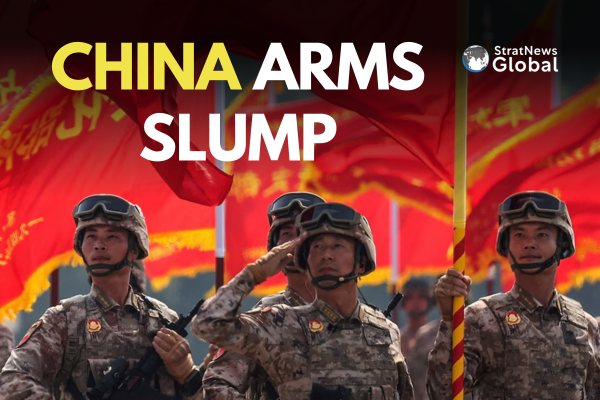
Revenues at China’s leading military companies fell sharply last year as corruption investigations disrupted arms procurement and contract approvals, according to a new study by the Stockholm International Peace Research Institute (SIPRI). The report contrasts China’s downturn with strong global growth in defence industries driven by ongoing wars in Ukraine and Gaza, and rising international tensions.
Corruption Allegations Delay Contracts
SIPRI said multiple corruption allegations within China’s arms procurement system led to postponed or cancelled contracts in 2024. Nan Tian, director of SIPRI’s Military Expenditure and Arms Production Programme, noted that the delays created “deep uncertainty” over the pace of China’s military modernisation and the rollout of new technologies.
The corruption crackdown, launched by President Xi Jinping in 2012, reached deeper into the military in 2023 when the elite Rocket Force came under investigation. Eight senior generals, including He Weidong, the nation’s second-highest-ranking officer and a member of the Central Military Commission, were expelled from the Communist Party on graft charges.
Regional Revenue Contrasts
SIPRI data showed that revenues of China’s top military firms fell 10% in 2024, while Japan’s rose 40%, Germany’s climbed 36%, and US defence companies saw a 3.8% increase. Globally, the world’s 100 largest arms firms recorded a 5.9% revenue rise to a record $679 billion. China’s decline made Asia-Oceania the only region where major defence firms reported lower earnings.
Despite decades of rising defence spending and an ongoing rivalry with the United States, China’s arms revenues declined amid tensions over Taiwan and the South China Sea. Analysts say the full impact of the corruption crackdown on China’s military build-up remains unclear.
Impact on Major Defence Firms and Modernisation Goals
Revenue fell across China’s largest state-owned arms manufacturers, including AVIC, Norinco and CASC. Norinco suffered the biggest drop, down 31% to $14 billion. Leadership changes at Norinco and CASC led to project reviews and delays, while AVIC’s aircraft production also slowed, SIPRI said.
Researcher Xiao Liang warned that the timeline for deploying advanced systems such as hypersonic missiles, drones and cyber capabilities may now be exposed. This uncertainty could affect the People’s Liberation Army’s goal of achieving full modernisation by its 100th anniversary in 2027.
Still, SIPRI expects China to sustain its long-term investment in defence. Liang said that while the corruption probes would bring “programme delays, higher costs and tighter control of procurement,” political backing for modernisation efforts would remain strong.
(with inputs from Reuters)