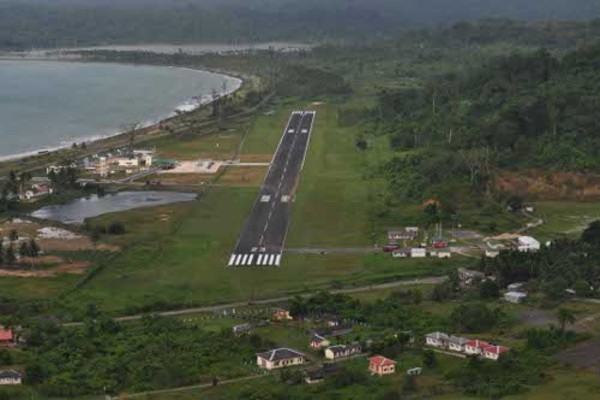
Few infrastructure projects in recent years have generated as much debate as the proposed development of Great Nicobar Island.
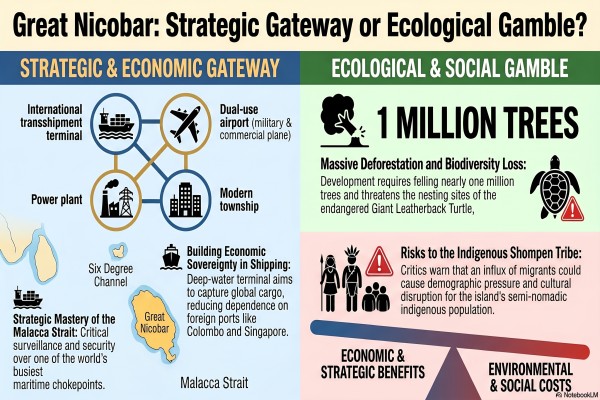
Estimated to cost between ₹72,000 crore and ₹92,000 crore, the project is among the most ambitious infrastructure initiatives ever undertaken in India’s island territories. It combines four interconnected components: an international container transhipment terminal, a dual-use international airport with military utility, a major power plant and a large township.
For the government, Great Nicobar represents a rare opportunity to transform a remote island into a strategic and economic asset. For critics, it raises difficult questions about environmental sustainability, indigenous rights and the long-term viability of development in one of India’s most fragile ecosystems.
At the heart of the project’s appeal is geography. Great Nicobar lies close to the Six Degree Channel and the approaches to the Malacca Strait, one of the world’s most important maritime chokepoints. A significant share of global trade and energy supplies passes through these waters every day.
Indian policymakers have long argued that the island’s location offers strategic advantages that remain underutilised.
The project therefore fits into a broader effort to strengthen India’s presence in the eastern Indian Ocean. Security planners see it as a means of improving surveillance, maritime domain awareness and military response times in a region where geopolitical competition is intensifying.
The proposed airport and associated military facilities would allow India to maintain a more persistent presence near critical sea lanes while enhancing its ability to respond to both security threats and natural disasters.
In strategic terms, the project is often viewed as part of India’s response to China’s expanding footprint across the Indian Ocean. By establishing significant infrastructure on Indian territory close to major shipping routes, New Delhi hopes to reinforce its role as the region’s primary security provider while advancing its Act East policy and SAGAR doctrine.
Yet the same strategic logic also exposes potential vulnerabilities. Great Nicobar is located in Seismic Zone V and sits near an active subduction zone. The 2004 Indian Ocean tsunami caused substantial land subsidence in parts of the island, highlighting the risks of concentrating critical infrastructure in a geologically unstable environment.
In a conflict scenario, a cluster of high-value assets concentrated in a single remote location could also become an attractive target.
Economically, the project aims to address a longstanding weakness in India’s maritime trade network. Despite being one of the world’s fastest-growing trading economies, India still depends heavily on foreign ports such as Colombo and Singapore for cargo transhipment.
Policymakers believe a deep-water transhipment terminal at Great Nicobar could capture part of this business, reduce dependence on foreign facilities and generate substantial economic activity through shipping, logistics and tourism.
The government also envisions the island developing into a regional commercial hub supported by the airport, township and associated infrastructure. Supporters point to projected employment generation and broader multiplier effects that could emerge from increased connectivity and investment.
However, questions about commercial viability persist. Unlike successful transhipment centres such as Singapore, Great Nicobar lacks an industrial hinterland capable of generating large volumes of cargo. Its isolation, more than 1,600 kilometres from mainland India, raises concerns about operating costs and long-term competitiveness.
The project will also face competition from established regional hubs as well as emerging Indian facilities such as Vizhinjam.
Construction itself presents formidable challenges. Almost all major equipment, construction material and specialised machinery will need to be transported to the island, potentially driving costs far beyond current estimates.
The most contentious aspects of the project concern its environmental and social consequences.
Great Nicobar is not an empty tract of land awaiting development. It is home to dense tropical rainforests, unique wildlife and indigenous communities whose presence predates the modern Indian state. Critics argue that large-scale construction will permanently alter an ecosystem that has remained largely undisturbed for centuries.
The project is expected to divert roughly 130 square kilometres of primary rainforest and require the felling of hundreds of thousands, potentially up to a million, trees. Environmental groups warn that compensatory afforestation elsewhere cannot replicate the ecological functions of an ancient island rainforest.
Particular concern surrounds Galathea Bay, one of the most important nesting sites for the endangered Giant Leatherback Turtle.
Scientists have questioned whether proposed mitigation measures, including the translocation of corals and other marine organisms, can realistically compensate for habitat loss.
Government agencies reject claims that environmental concerns have been ignored. Officials note that the project underwent review by specialised scientific institutions and that more than 80 percent of the island will continue to remain under protected status.
Environmental clearances include dozens of conditions, while substantial funding has been earmarked for conservation and habitat protection programmes.
The debate over indigenous communities is equally complex. The government maintains that no physical displacement of tribal populations is planned and that safeguards have been incorporated into project design. Welfare measures and restrictions on access to tribal areas are intended to minimise disruption.
Critics remain unconvinced. They argue that the project undermines the spirit of tribal protections and could expose vulnerable communities, particularly the semi-nomadic Shompen tribe, to demographic pressures, cultural disruption and disease.
The projected influx of migrants and workers could fundamentally alter the island’s social balance, regardless of whether direct displacement occurs.
What makes Great Nicobar unusual is that it is neither purely a commercial venture nor solely a military installation. It sits at the intersection of trade, defence, tourism, environmental conservation and tribal policy.
Its success therefore cannot be measured only in terms of cargo throughput, investment figures or military capability.
The larger question is whether India can reconcile strategic necessity with ecological stewardship and social responsibility.
The real test will begin long after construction starts. Monitoring environmental impacts, enforcing conservation commitments, regulating development and protecting indigenous communities will require sustained political attention for decades.
For New Delhi, Great Nicobar is ultimately a test case for a broader challenge confronting rising powers: how to pursue national security and economic development without sacrificing the environmental and cultural assets that make such territories unique.
Whether the project becomes a model of balanced development or a cautionary tale will depend not on plans and projections, but on what happens on the ground in the years ahead.