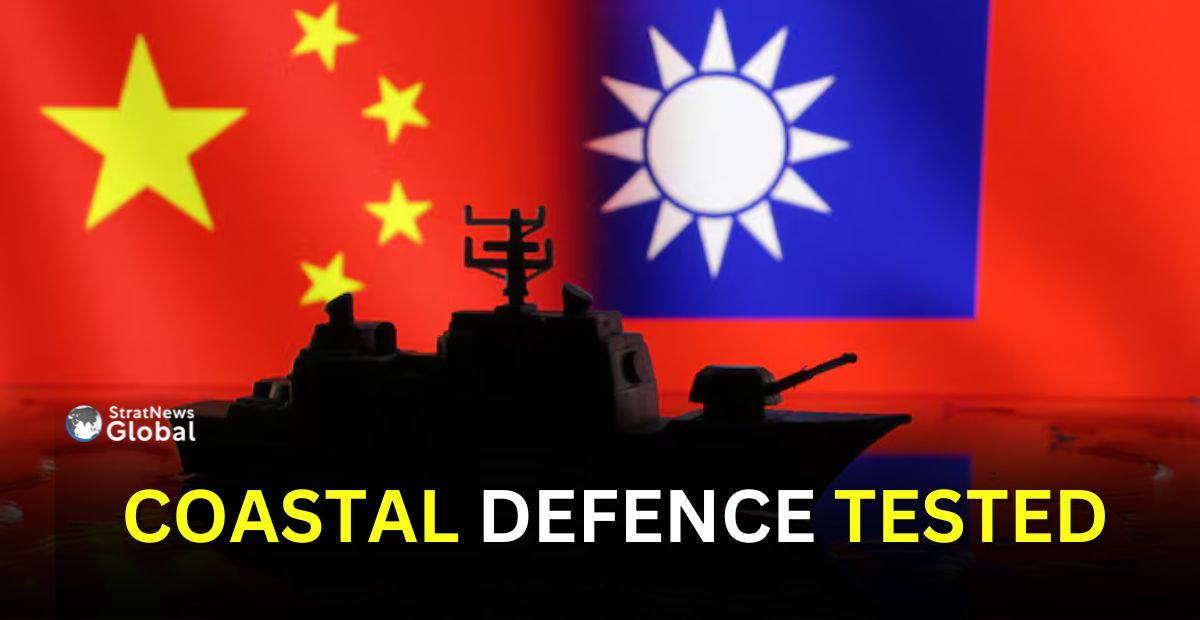
Taiwan’s military on Tuesday staged a coastal defense drill simulating the destruction of an invading Chinese force, using rockets and artillery to repel a mock amphibious landing. Officials said the exercise was designed to mirror more realistic battlefield conditions, with troops given less advance notice to prepare.
China, which claims self-governed Taiwan as part of its territory, has not ruled out using force to bring the island under Beijing’s control. Chinese military aircraft and naval vessels continue to conduct near-daily operations around Taiwan, maintaining steady pressure on the island.
Growing Chinese Pressure
The beaches and mud flats on Taiwan’s west coast, directly facing China across the Taiwan Strait, are seen as the most likely location for an attempted landing by the Chinese military in the event of any invasion.
The drill was conducted simultaneously from eight positions across a 20 km (12 miles) stretch of coast around Taichung in central Taiwan.
Taiwan’s government is modernising its armed forces, adding new and more mobile weapons but also making its training less predictable and more like the situation troops would face in actual combat.
Artillery commander Ong Yih-ming told reporters the drills were no longer about set-piece manoeuvres.
“What is different about this training compared with the past is that we are no longer conducting heavy artillery firing in a fixed, routine formation as before,” he said.
“The timing for entering positions this time was based on realistic combat conditions. So I believe this training posed a considerable level of difficulty for our troops.”
Advanced Weapons Tested
The drill used domestically developed, truck-mounted Thunderbolt-2000 rocket systems, U.S.-made Paladin howitzers, anti-tank missiles, artillery and mortars to establish a “kill zone” to stop an amphibious assault.
The military said this was the first time in seven years the Thunderbolt-2000 had conducted live-fire shooting in an operational area, a system developed for its long-range suppression capability and high mobility.
“What was different this time compared with the past is that previously, we would usually enter the position one week in advance and complete firing preparations,” said rocket commander Liao Neng-cheng.
“This time, however, we arrived at the position only one day before and carried out the relevant position preparations. So our preparation time was relatively tight.”
Taiwan’s government rejects Beijing’s sovereignty claims, saying only the island’s people can decide their future.
(With inputs from Reuters)